India's first digital revolution in healthcare— AIIMS transformation

A transformation led by Tata Consultancy Services in partnership with All India Institute of Medical Sciences and the Ministry of Health and Family Welfare — reimagining public healthcare delivery at scale through a digitally enabled OPD model serving over 10,000 patients a day.

6 to 2 hrs

Waiting time reduced

20% to 73%

Patients coming with appointments

10 to 52

Registration counters

83%

Patients appreciated changes

10.5 Lakh+

Pilot e-hospital appointments

Background

AIIMS — India's
largest public OPD

All India Institute of Medical Sciences is India’s premier public healthcare institution — serving patients who travel from across the country for advanced and affordable care. With nearly 10,000 patients visiting daily, the OPD system faced extreme operational pressure, long wait times, overcrowding, and significant strain on infrastructure and clinical workflows.

Patients travelling overnight from states such as Bihar, Uttar Pradesh, Uttarakhand, and Rajasthan often waited several hours for brief consultations, while facilities operated far beyond their designed capacity. Transforming AIIMS required redesigning patient-facing processes at scale — rapidly, and without disrupting ongoing clinical care.

The Problem

Three systemic failures  at India's
flagship hospital

ai Notes

Inefficient Appointment System 

Only 20% of patients had prior appointments, while the rest queued from early morning — overwhelming hospital operations and creating unpredictable patient flow.

80% of daily patients had no appointment
ai Meter

Overcrowding & Siloed Facilities

With multiple attendants accompanying each patient, daily footfall exceeded 40,000. Disconnected registration, OPD, diagnostics, and billing systems left patients navigating a highly fragmented care journey.

No coordination across registration, OPD, labs, billing
Healthcare

No Digital Backbone

Only 10 counters served the hospital, while departments and labs functioned in silos. Doctors spent valuable time handling administrative queries alongside patient care.

60 departments & 170 labs — not electronically linked
banner2

The Solution

Reimagined  from the ground up
— built in 45 days

Developed by TCS in collaboration with AIIMS and the Ministry of Health — India's first hospital transformation using innovative process engineering techniques.
Two guiding principles drove everything: every patient must have an appointment, and one attendant per patient. All infrastructure, technology, and staffing was built to enforce these at 10,000 patients a day.
ecosystem

Appointment-First Model

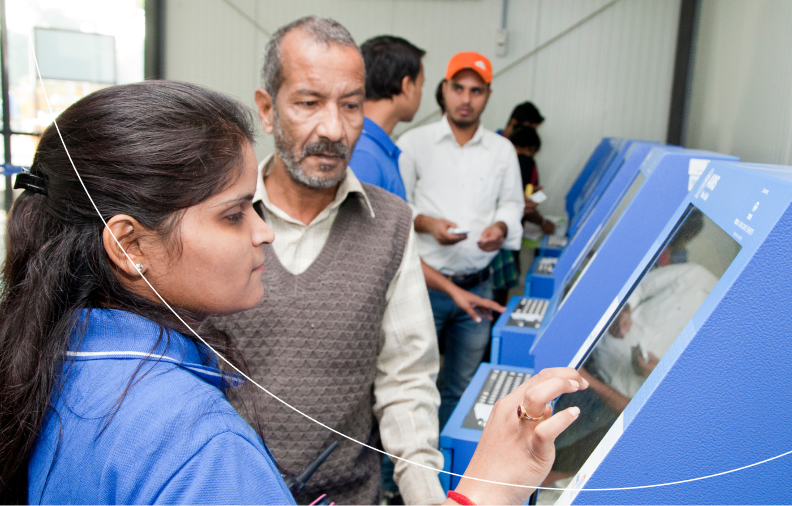
Appointment mandatory for all consultations, labs, radiology, and procedures. Multiple channels created: website, IVRS, call centre, and web kiosks on campus.

stack

Centralised Patient Reception Centre (PRC)

New 9,700 sq ft structure built in 45 days. 52 counters across Fast Track, Current Booking, and UHID pavilions — handling 2,250 registrations per hour.

stack

Digital Backbone — e-Hospital & UHID

Unique Health Identification numbers issued to all patients. 60 departments and 170 labs electronically linked via e-Hospital software for seamless record retrieval.

stack

Staggered Patient Flow & Batch Movement

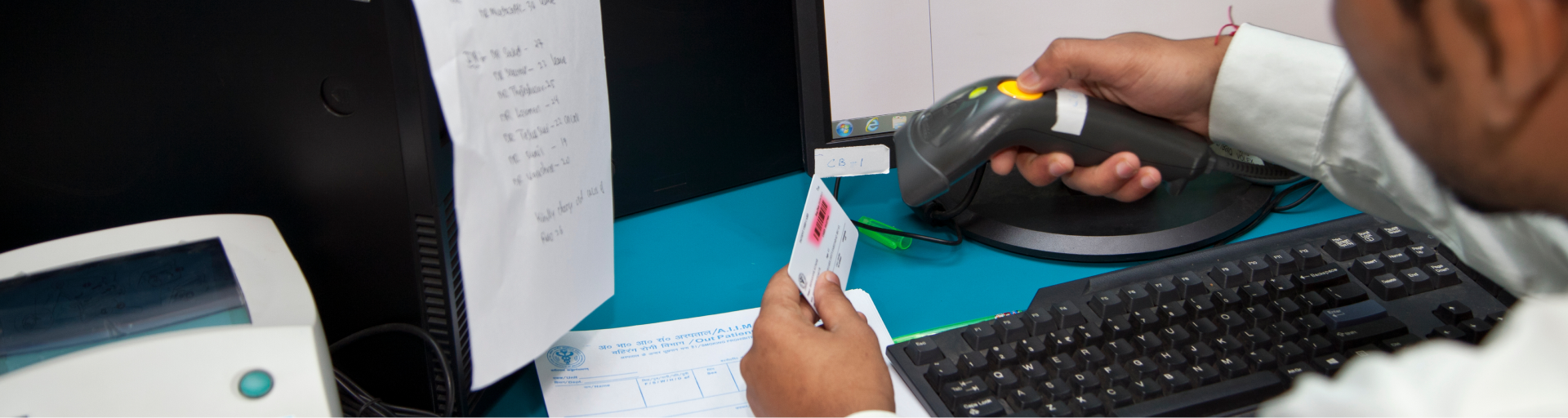
Patients moved from PRC → Waiting Hall → OPD buildings in controlled batches. Barcode entry/exit scans track each patient at every stage of the journey.

stack

Patient Care Coordinators

Compassionate PCCs deployed at every touchpoint — guiding, informing, and supporting patients so doctors can focus entirely on clinical care.

Patient Journey

Five steps — from
arrival to exit

Every patient follows the same structured journey, tracked digitally at each stage.
01

Patient Reception Centre

Confirm or book appointment · UHID card issued · Wristband and barcode sticker printed

02

Waiting Hall

Directed via yellow pedestrian track · Fast Track and Current Booking seated separately

03

Entry Scan

Barcode scanned at OPD building entry · Only valid-appointment patients admitted · Seated in sequence

04

Consultation & Exit Scan

Called to consultation room in sequence · PCC performs exit scan after consultation

05

Single Window Exit

Labs, procedures, future visits, billing — all at one counter · No further wandering

Digital Backbone

Technology connecting every
stage of the patient journey

Unique Health

Unique Health ID (UHID)

Permanent PVC card issued to every patient. Details stored against UHID — enabling identification, tracking, and record retrieval at every visit.

Barcoded

Barcoded OPD Card

Barcode sticker printed at PRC carries appointment details. Scanned at OPD entry and exit — tracking patient movement and completing the digital consultation record.

Hospital

e-Hospital Integration

All 60 departments and 170 laboratories electronically linked. Prescriptions, investigation reports, and billing unified — enabling seamless record retrieval across the hospital.

170 labs

Electronically linked for the first time

11 locations

Multi-zonal PA system for real-time patient communication

1:1

Patient-to-attendant ratio enforced via wristband access control

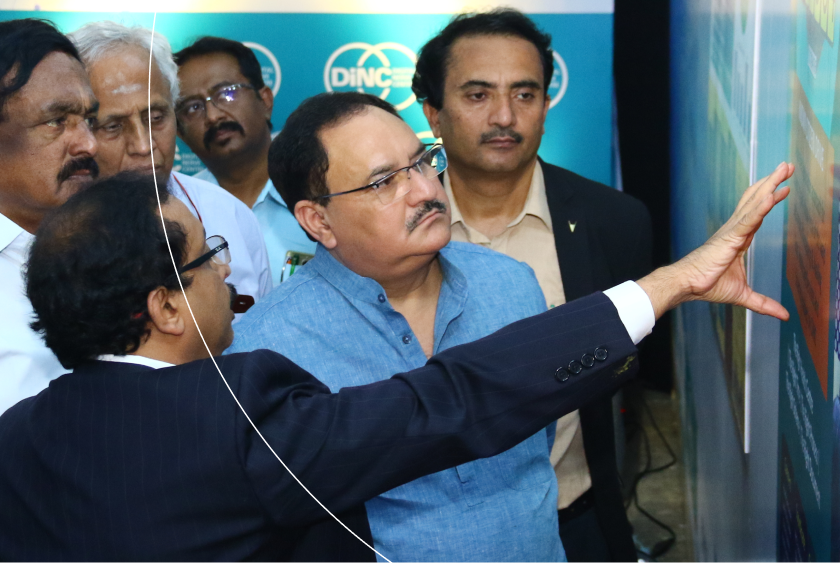
Excited to see a successfully implemented patient centric care coordination model augmenting public health system & India centric healthcare delivery model in Kolar. IT combines high- end technology, people & process very efficiently.

Shri J. P. Nadda

Minister of Health and Family Welfare, Government of India
Chandrababu Naidu

Excited to see a successfully implemented patient centric care coordination model augmenting public health system & India centric healthcare delivery model in Kolar. IT combines high- end technology, people & process very efficiently.

Shri J. P. Nadda

Minister of Health and Family Welfare, Government of India
Chandrababu Naidu
Doctor

What could this look like
in your district?

Discover how the DiNC model can help strengthen and transform healthcare delivery across your district or state through a data-driven, integrated, and outcome-focused approach.

If you would like to learn more about the model, explore its potential applicability in your context, or discuss partnership opportunities, we invite you to submit an enquiry. We will reach out to you to answer your questions, provide additional information, and discuss how the model can support your healthcare and development priorities.

ENQUIRE NOW